Swim at Your Own Risk
 The Fukushima nuclear plants blew 4,385 times the legal limit for radiation levels in nearby seawater.
Could this mean a glowing future for water powered vehicles? Other than that, I’m still okay with the view that, if we must have electric cars, nukes are the best way to make them go.
Libya Leadership

Even Eugene Robinson is bewildered by the Libya Mission.
So what the hell are we doing? I realize that President Obama and his advisers have answered this question many times, but I feel it’s necessary to keep asking until the answers begin to make sense.
Replacement Fear
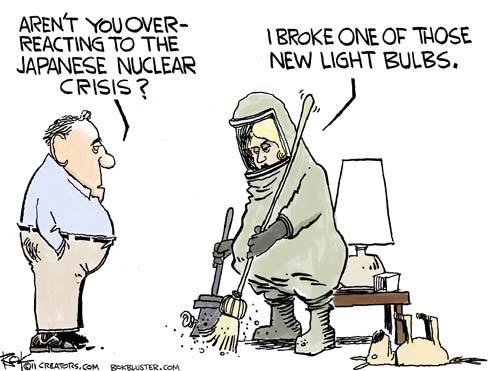
Officials are downplaying the risk of radiation from Japan reaching the U.S. so, as a replacement concern, here are the EPA instructions for cleaning up a broken CFL (Curley Federal Lightbulb).
Before Cleanup
- Have people and pets leave the room, and avoid the breakage area on the way out.
- Open a window or door to the outdoors and leave the room for 5-10 minutes.
- Shut off the central forced-air heating/air conditioning (H&AC) system, if you have one.
- Collect materials you will need to clean up the broken bulb:
- Stiff paper or cardboard
- Sticky tape (e.g., duct tape)
- Damp paper towels or disposable wet wipes (for hard surfaces)
- Glass jar with a metal lid (such as a canning jar) or a sealable plastic bag(s)
Cleanup Steps for Hard Surfaces
- Carefully scoop up glass fragments and powder using stiff paper or cardboard and place debris and paper/cardboard in a glass jar with a metal lid. If a glass jar is not available, use a sealable plastic bag. (NOTE: Since a plastic bag will not prevent the mercury vapor from escaping, remove the plastic bag(s) from the home after cleanup.)
- Use sticky tape, such as duct tape, to pick up any remaining small glass fragments and powder. Place the used tape in the glass jar or plastic bag.
- Wipe the area clean with damp paper towels or disposable wet wipes. Place the towels in the glass jar or plastic bag.
- Vacuuming of hard surfaces during cleanup is not recommended unless broken glass remains after all other cleanup steps have been taken. [NOTE: It is possible that vacuuming could spread mercury-containing powder or mercury vapor, although available information on this problem is limited.] If vacuuming is needed to ensure removal of all broken glass, keep the following tips in mind:
- Keep a window or door to the outdoors open;
- Vacuum the area where the bulb was broken using the vacuum hose, if available; and
- Remove the vacuum bag (or empty and wipe the canister) and seal the bag/vacuum debris, and any materials used to clean the vacuum, in a plastic bag.
- Promptly place all bulb debris and cleanup materials, including vacuum cleaner bags, outdoors in a trash container or protected area until materials can be disposed of properly.
- Check with your local or state government about disposal requirements in your area. Some states and communities require fluorescent bulbs (broken or unbroken) be taken to a local recycling center.
- Wash your hands with soap and water after disposing of the jars or plastic bags containing bulb debris and cleanup materials.
- Continue to air out the room where the bulb was broken and leave the H&AC system shut off, as practical, for several hours.
Cleanup Steps for Carpeting or Rugs
- Carefully scoop up glass fragments and powder using stiff paper or cardboard and place debris and paper/cardboard in a glass jar with a metal lid. If a glass jar is not available, use a sealable plastic bag. (NOTE: Since a plastic bag will not prevent the mercury vapor from escaping, remove the plastic bag(s) from the home after cleanup.)
- Use sticky tape, such as duct tape, to pick up any remaining small glass fragments and powder. Place the used tape in the glass jar or plastic bag.
- Vacuuming of carpeting or rugs during cleanup is not recommended unless broken glass remains after all other cleanup steps have been taken. [NOTE: It is possible that vacuuming could spread mercury-containing powder or mercury vapor, although available information on this problem is limited.] If vacuuming is needed to ensure removal of all broken glass, keep the following tips in mind:
- Keep a window or door to the outdoors open;
- Vacuum the area where the bulb was broken using the vacuum hose, if available, and
- Remove the vacuum bag (or empty and wipe the canister) and seal the bag/vacuum debris, and any materials used to clean the vacuum, in a plastic bag.
- Promptly place all bulb debris and cleanup materials, including vacuum cleaner bags, outdoors in a trash container or protected area until materials can be disposed of properly.
- Check with your local or state government about disposal requirements in your area. Some states and communities require fluorescent bulbs (broken or unbroken) be taken to a local recycling center.
- Wash your hands with soap and water after disposing of the jars or plastic bags containing bulb debris and cleanup materials.
- Continue to air out the room where the bulb was broken and leave the H&AC system shut off, as practical, for several hours.
Not so Crazy

The UN Security Council finally authorized the use of force against Libya. Gadhafi ordered a cease fire as promptly as he handed over his wmd after seeing Saddam stetch a rope in 2003.
 Still, some are skeptical and, according to Al Jazeera, the fighting continues.
A story in the Guardian calls the cease fire a crafty move by Gadhafi to consolidate his gains.
Horse Sense

I got this idea from a Rich Lowry column.
Osama bin Laden famously talked of the weak horse and the strong horse. Obama is the show horse.
For the record, the Show Horse picked Kansas to beat Ohio State in the March Madness final in April.